
Using advanced Spanish colloquial expressions in your conversations with Spanish speakers makes all the difference in your Spanish level. It’s not easy to get used to using them, but if you do, that’s when you’ll really speak like a native, which for language learners, is our dream.
While writing this article on advanced Spanish colloquial expressions, I discovered the meaning of these expressions in English, and I decided to incorporate at least one of them into my conversational English.
I have also realised that not all of the advanced Spanish colloquial expressions which you are going to learn in this article are used throughout the Hispanic world (Spain and Latin America).
So, keep in mind that these advanced Spanish colloquial expressions are commonly used in conversational Spanish in Spain.
Even if you are just starting your journey as a Spanish learner, it is good to familiarise yourself with these colloquial expressions. I still remember the first colloquial expression I learned in English:
“Every cloud has a silver lining.”
At that time, when I was a beginner, I had enough just trying to communicate short and simple messages in English at the coffee shop, at the bank, at the supermarket… However, being familiar with that particular colloquial expression helped me to identify it in conversations with English speakers or in television series I watched.
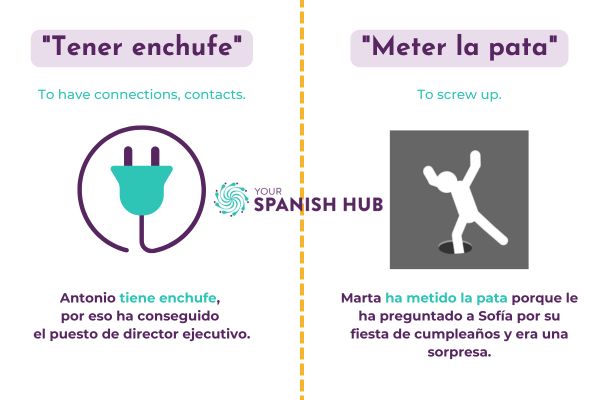
This expression means to have influence over someone in order to obtain a favour.
The most common context in which it is used is when trying to get a job.
For example, here in Spain, we all know someone who is “family of someone” or “friend of someone” and who, thanks to this connection, has obtained a job or a promotion, even though they do not have the training or skills that another person would have in their place to carry out the same job.
Example:
Antonio tiene enchufe, por eso ha conseguido el puesto de director ejecutivo.
Antonio has connections, that’s why he got the position of executive director.
This expression means to make a mistake unintentionally or to say something inappropriate unintentionally.
The origin of this expression has to do with the traps that hunters set in the forest to catch animals. “Pata” is the equivalent of the extremity of the “leg” for an animal. When the animal makes the involuntary mistake of stepping on the trap with its paw, it is caught.
Therefore, “meter la pata” is to make a mistake.
Example:
Marta ha metido la pata porque le ha preguntado a Sofía por su fiesta de cumpleaños y era una sorpresa.
Marta made a mistake because she asked Sofia about her birthday party and it was a surprise.
This expression means that someone is crazy. It can have a positive or negative connotation, depending on the context.
The origin of this expression is none other than the somewhat unpredictable and chaotic behaviour of goats in the countryside. For farmers, it is much more difficult to manage a flock of goats than a flock of sheep, for example.
Example:
A Inma le gusta nadar en el río en invierno… ¡Está como una cabra!
Inma likes to swim in the river in winter… She’s crazy!
This expression means to find a solution to a problem.
The origin of this expression has to do with Spanish history, and dates back to 1808, when the Spanish War of Independence (1808 – 1817) began, against the usurpation of the throne by the Frenchman Joseph Napoleon, Napoleon Bonaparte’s older brother.
French uniforms had a white (blanco) breastplate, with two crossed white straps on the blue background of their uniform.
The expression “dar en el blanco” would therefore come, according to history, from the call to throw stones and other projectiles at the centre of the body of the French, whom were occupying troops in Spain.
Example:
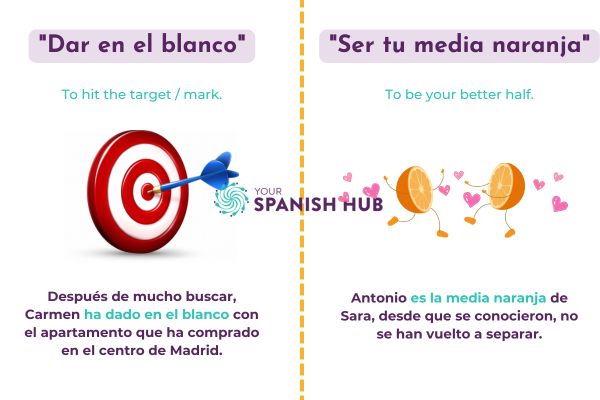
Después de mucho buscar, Carmen ha dado en el blanco con el apartamento que ha comprado en el centro de Madrid.
After much searching, Carmen has hit the mark with the apartment she had bought in the centre of Madrid.
This expression means that someone is the perfect person to be your life partner.
The origin of this expression can be found in Ancient Greece.
The expression first appears in a work by Plato called The Symposium, written around 380-350 BC.
This work is precisely about the search for love and one of the main characters, Aristophanes, explains that “humans, being so perfect, have a spherical shape and compares them to oranges.” From there, the comparison of the beloved with that “better half” would begin.
Example:
Antonio es la media naranja de Sara, desde que se conocieron, no se han vuelto a separar.
Antonio is Sara’s better half, ever since they met, they have not separated since.
The look of amazement and delight on your native friends’ faces, when they hear you using these advanced Spanish colloquial expressions in conversations with them, will make the effort you put into memorising and practising out loud worthwhile.
Try and have fun using these advanced Spanish colloquial expressions in your next conversation with a native.
This expression means to make an extraordinary, even wasteful, expense beyond that person’s means.
The expression has its origins in the custom that existed at the end of the 18th century and during the 19th century in Spain of throwing furniture and household objects out of the window (literally) when someone won the lottery.
Why did they do this?
Because the biggest dream of someone who won the lottery at that time was not to go on a trip or buy a new car, but to renew the furniture and household goods in the house.
Example:
Para la boda de su hija Miriam, Susana está tirando la casa por la ventana. ¡Ha contratado a un chef que tiene una estrella Michelín!
For her daughter Miriam’s wedding, Susana is going all out. She has hired a Michelin-starred chef!
This expression means that something is very expensive or that something costs a lot of effort and sacrifice.
The expression has its origins in the 16th century, when the explorer from La Mancha, Diego de Almagro, on his journey to the New World, lost an eye due to an arrow wound during the siege and battle to conquer an Inca fortress.
Upon returning to Spain and recounting the events to Emperor Charles V, Diego de Almagro explained that “the business of defending the interests of the crown had cost him an eye.”
Example:
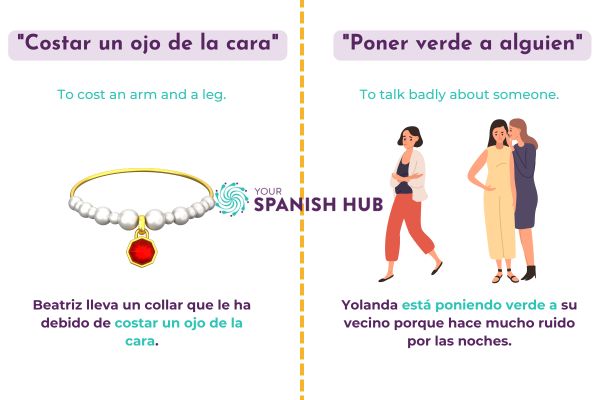
Beatriz lleva un collar que le ha debido de costar un ojo de la cara.
Beatriz is wearing a necklace that must have cost her an arm and a leg.
This expression means to speak badly of a person or to criticise a person who is not present in the conversation.
The most widely accepted version of the origin of this expression has to do with the bruises that appear on our skin after receiving a blow. The initial colour of these bruises is dark purple, but after a few days they take on other tones: green, yellowish.
Well, it is that green colour of bruises that is identified with criticising or speaking badly of a person who is not present in the conversation, since they would be being “hit” verbally, with words.
Example:
Yolanda está poniendo verde a su vecino porque hace mucho ruido por las noches.
Yolanda is talking badly about her neighbour because he makes a lot of noise at night.
This expression is used to advise someone who is making their life unnecessarily complicated.
The original expression, which dates back to the 17th century, was “looking for five feet on a cat / buscarle cinco pies al gato” and first appeared in ancient texts such as the Tesoro de la lengua castellana o española (1611) by Sebastián de Covarrubias, who explained that a cat’s tail counted as a fifth foot.
El cambio de cinco a tres pies se popularizó gracias a Miguel de Cervantes. En su obra maestra, El ingenioso hidalgo Don Quijote de la Mancha (1605), escribió “No le busque usted tres pies al gato”.
The change from five to three feet was popularised by Miguel de Cervantes. In his masterpiece, Don Quixote (1605), he wrote “Don’t look for three feet on a cat.”
Experts do not know if it was an intentional mistake by the author or simply one of the many follies of Don Quixote’s unconscious and uncontrolled mind.
Example:
El coche que te gusta es bueno, bonito y barato. Cómpralo ya y no le busques tres pies al gato.
The car you like is good, nice and cheap. Buy it now and stop splitting hairs.
It is said that someone does not mince words when he tells the truth even if it hurts or bothers.
Example:
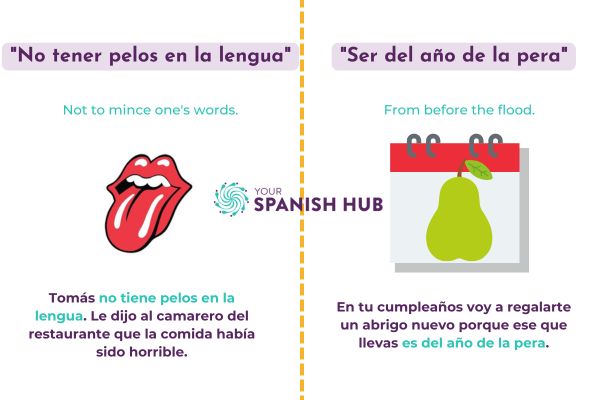
Tomás no tiene pelos en la lengua. Le dijo al camarero del restaurante que la comida había sido horrible.
Thomas is not one to mince his words. He told the waiter at the restaurant that the food had been horrible.
Can I tell you a secret? When I want to reach the heart or the mind of a bilingual friend (Spanish – English) or one of my advanced Spanish students, I always use English, I speak to them in their native language.
Why?
Because the sensation, what one feels, the way the words and the message are received, is just different.
If you incorporate the expressions you are learning in this article into your conversational Spanish, the level of connection you will have with the Spanish speakers you interact with will be much greater.
This expression means that something is old, outdated, obsolete or out of fashion.
This expression has a very interesting origin and refers to the famous Catalan bandit Perot Rocaguinarda, known by the nickname “La Pera” (17th century). His fame at that time was such that Miguel de Cervantes was inspired by him to create the character of Roque Guinart in Don Quixote.
From generation to generation, and through oral transmission, stories about the famous bandit “La Pera” have been told.
Therefore, saying that “something is from the year of the pear / algo es del año de la pera” refers to the time in which the Catalan bandit Perot Rocaguinarda lived, many, many years ago.
Example:
En tu cumpleaños voy a regalarte un abrigo nuevo porque ese que llevas es del año de la pera.
On your birthday I’m going to give you a new coat because the one you’re wearing is from before the flood.
This expression is used to refer to a person who has had no shame and constantly takes advantage of the goodwill of others.
Example:
Mi vecino tiene más cara que espalda: si ve que mi coche no está en el garaje, usa mi plaza para dejar el suyo.
My neighbour has more nerve than backbone: if he sees that my car is not in the garage, he uses my space to leave his.
This expression means that an extra boost of energy is needed to do a task with dedication and diligence.
Example:
Javi, ponte las pilas que tenemos que acabar este informe antes del viernes.
Javi, get your act together, we have to finish this report before Friday.
It is said that someone is “en la edad del pavo” when they are in their teens and their behaviour is a little rebellious and irrational.
The origin of this expression is directly related to the behaviour of young turkeys, which can be clumsy, restless and insecure. For example, when a turkey feels threatened, it will often run in circles instead of running away.
This generated a direct comparison with the behaviour of adolescents.
Example:
Mi sobrina está en la edad del pavo y ha empezado a salir con chicos.
My niece is in her teens and has started dating guys.
This expression means to have and get something in abundance, specifically food or money (eat a lot or become rich).
The origin of this expression has to do with the origin of footwear itself. In the Middle Ages, boots (usually made of leather) were footwear exclusive to the upper and wealthiest classes of society.
These rich people who could afford boots were also the ones who ate and drank the best and did the best business.
Example:
El sábado fui a casa de mi tío y cocinó paella para toda la familia… ¡Nos pusimos las botas!
On Saturday I went to my uncle’s house and he cooked paella for the whole family… We stuffed ourselves!
***
El sector de las autocaravanas se ha puesto las botas después del COVID.
The motorhome sector has made a killing after COVID.
I admit that it is difficult to start using these expressions, and only if you have an advanced level of grammar and vocabulary, as well as good fluency in your Spanish, will you feel comfortable enough to start using these phrases confidently in your conversations.
An idea that occurs to me and that could be a first step to integrate these expressions into your Spanish is to start using them in written texts: emails, WhatsApps, text messages, comments on social media…
Also notice, especially on social media, when natives use these expressions when commenting and writing.
If you want to start practising these and many other advanced Spanish colloquial expressions with the help, guidance and supervision of an accredited native teacher, I invite you to book a trial class with us and see how we work online with our students.
And remember that if you start using the expressions you have learned in this article, the level of connection and understanding with the Spanish speakers you speak to will be much greater.
As Nelson Mandela said:
“If you speak to a man in a language he understands, that goes to the head. If you talk to him in his language, that goes to the heart.”